
A First Week at 164 TH/s: What the Numbers Have to Cover
One miner, one pool account, seven days. At 164 TH/s the credit is 0.00007357 BTC a day, which is $6.23 gross at $84,692 and $5.98 after the listed 4% on the block-reward component. That is the whole income side of the ledger. Everything else in the first week is a cost or a setting, and the setting that surprises new operators most is the payout mode.
Key takeaways
- 164 TH/s credits 0.00007357 BTC a day, or $6.23 gross and $5.98 net of the listed 4%.
- PPS+ settles hourly against current difficulty; PPLNS pays after 6 confirmations over the last 5 difficulty rounds.
- At 20 J/TH the machine draws 3.28 kW, which is $4.72 a day at $0.06 per kWh.
- Check pool hashrate and the listed rates before pointing hardware at an account, not after.
One machine, two ledgers
A single rig is a small business with one revenue line and several cost lines. The revenue line is decided by hashrate, network difficulty and price, and none of those are under your control. The cost lines are power, cooling, hardware depreciation and any hosting fee, and all of them are. Confusing the two is how a first week turns into an argument with yourself about whether the machine is broken.
So write both sides down before the first share reaches the pool. The income side takes one multiplication. The cost side takes a tariff, a wattage and an honest estimate of how long the hardware will stay competitive. Neither list needs software, and having them on paper makes the dashboard's numbers easier to interpret when they move.
The three lines that matter in week one
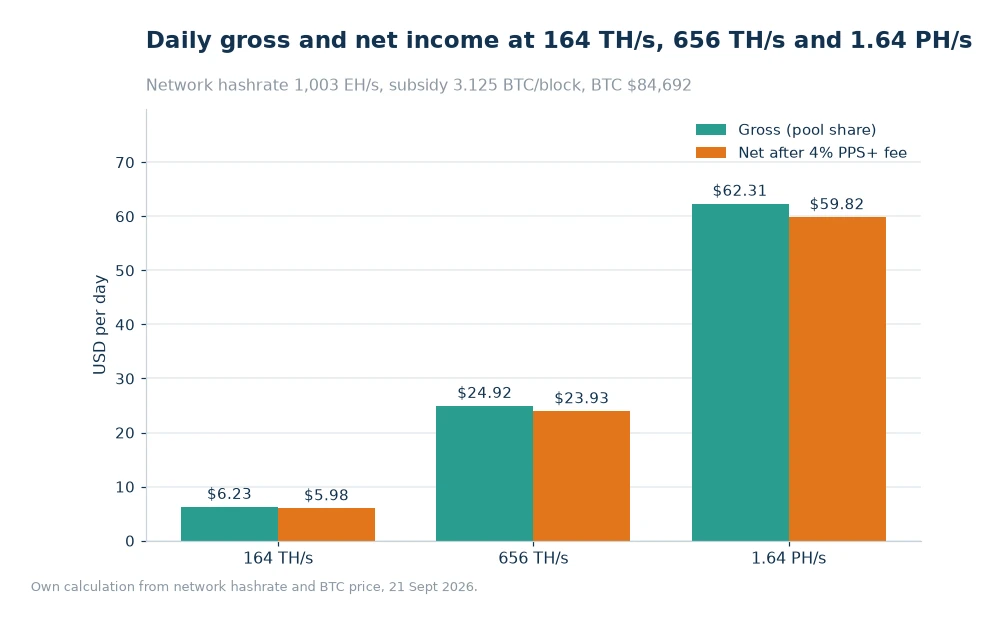
Hashrate scales the credit in a straight line. The table keeps the same rig efficiency and shows what happens as the operation grows from one machine to a small rack, with the net column reflecting the listed 4% on the block-reward part only.
| Line | 164 TH/s | 656 TH/s | 1.64 PH/s |
|---|---|---|---|
| BTC per day | 0.00007357 | 0.00029428 | 0.00073571 |
| Gross USD per day | $6.23 | $24.92 | $62.31 |
| Net USD per day | $5.98 | $23.93 | $59.82 |
| BTC per hour | 0.0000030654 | 0.000012262 | 0.000030655 |
The hourly row is the one to check against the pool's credit history. Hourly settlement means twenty-four entries a day at the smallest tier, and a gap is easier to see in a list of small numbers than in a monthly total that has already been rounded.
Payout mode is a setting, not a default to ignore
PPS+ is the default and pays hourly against current difficulty, with the listed 4% applied to the block-reward part and the listed 2% to the transaction-fee part. PPLNS pays once a block reaches 6 confirmations and shares the miner's slice across the last 5 difficulty rounds, with the listed 2% on both components combined. The two rates land on different money, which is why a single blended percentage is the wrong way to compare them.
The practical difference is variance. PPS+ turns a lucky pool into an ordinary week and an unlucky one into the same ordinary week. PPLNS keeps the luck, so a short sample can sit above or below the average for a while. For a first week at 164 TH/s, the steadier series is easier to learn from, and the choice can be revisited once the machine's behaviour is familiar.
Worked example
Run the arithmetic from network totals down to the hourly credit.
- Blocks a day: 144. Subsidy: 3.125 BTC. Network output: 450 BTC a day.
- BTC per TH/s: 450 ÷ 1,003,107,267 = 0.00000044861.
- 164 TH/s: 164 × 0.00000044861 = 0.00007357 BTC.
- Gross value: 0.00007357 × 84,692 = $6.23.
- Listed 4% on the block reward: 6.23 × 0.04 = $0.25, so net is $5.98.
- Hourly: 0.00007357 ÷ 24 = 0.0000030654 BTC, about $0.26.
- Four machines: 4 × 0.00007357 = 0.00029428 BTC, or $24.92 gross.
- Ten machines: 10 × 0.00007357 = 0.00073571 BTC, or $62.31 gross and $59.82 net.
The line the pool never sees
Power decides whether the credit is income or a subsidy to the electricity supplier. At 20 J/TH, 164 TH/s draws 3.28 kW, or 78.72 kWh a day. At $0.06 per kWh that is $4.72, which leaves $1.26 a day from the $5.98 net credit before hardware, cooling and any fee. At $0.10 per kWh the same machine costs $7.87 and the week is negative.
That is the honest version of the calculation, and it explains why miners care about tariffs more than they care about headlines. A 30% move in the coin price changes the credit by 30%. A one-cent move in the power rate changes the cost by 17% at this draw. The second number is often easier to negotiate than the first is to predict.
Cooling belongs on the same line, even when it is invisible. In a home setup the fans move heat into the room and the room eventually reaches the air conditioning, so the meter at the wall is not the whole bill. In a hall the surcharge is usually folded into the rate. Either way the figure to use is the all-in cost per kilowatt-hour, not the tariff on the supply contract.
What to look at on the pool side first
Before the first machine is pointed anywhere, read the pool's own numbers. The ViaBTC Bitcoin Mining front page lists the coins on offer, the two payout modes and the account tools, which is enough to decide whether the setup fits. Then look at the live pool state page for hashrate and luck, because those describe the pool you are actually joining rather than the one in a review.
Read the listed rates in full as well. The 4% and the 2% apply to different components, and a schedule that states both is more useful than a headline figure that blends them. Withdrawal terms matter too: mining payouts carry no fee, which is worth confirming before you plan a monthly transfer.
What a normal week looks like
The first day is the least representative. A machine that has just been powered on may still be finishing firmware work, and the pool's hashrate estimate needs a few hours of shares before it settles. Give the account 48 hours before judging the reading, and compare the same hour each day rather than a morning figure against an evening one.
Watch the difficulty line too. Adjustments land every 2,016 blocks, and the estimate on 21 Sept 2026 pointed to a 2.12% cut, which at constant hashrate lifts the credit by roughly the same proportion. A week that includes an adjustment is not comparable with one that does not, so note where the boundary fell before drawing conclusions about the machine.
Frequently asked questions
How much does 164 TH/s earn in a day?
At the 21 Sept 2026 inputs, 0.00007357 BTC, which is $6.23 gross at $84,692 and $5.98 after the listed 4% on the block-reward component.
Should a new miner start on PPS+ or PPLNS?
PPS+ is the default and settles hourly against current difficulty, while PPLNS waits for six confirmations and spreads the miner's slice over the last five difficulty rounds.
What does the pool charge on a payout?
The listed 4% applies to the PPS-settled block reward and the listed 2% to the PPLNS-distributed components, so the two rates never apply to the same coins.
Start with the cost line, not the coin price
Before the machine runs a full week, know the tariff, the draw and the daily credit. If the gap between the last two is positive at a power rate you can still get next year, the setup has a foundation. If it only works at a price you hope for, nothing in the pool's feature list changes that.
Then let the first seven days produce twenty-four credits a day and compare the total with the arithmetic above. A week that lands within a few percent of $43.61 gross at 164 TH/s, which is seven times $6.23, means the machine and the account agree with each other.
Sources: the ViaBTC home, pool state and pricing pages for payout modes and listed rates[1]. Figures read 21 Sept 2026: 1,003 EH/s, 132.76 T, 3.125 BTC per block, 144 blocks a day, BTC $84,692. Published 22 Oct 2026; results assume continuous uptime and a constant difficulty.